




By Kiso Simon
Water scarcity has become a painful and enduring reality for residents of Piwoyi, a community in Lugbe along Airport Road, under the Abuja Municipal Area Council (AMAC).
For years, the area has suffered acute water shortages due to the absence of government provided pipe borne water, a situation residents attribute to prolonged government neglect – a community less than five kilometres from the city centre.
The lack of public water infrastructure has forced residents to resort to drilling private boreholes, many of which are now commercialized. This has placed an enormous financial burden on households already grappling with the country’s harsh economic conditions.
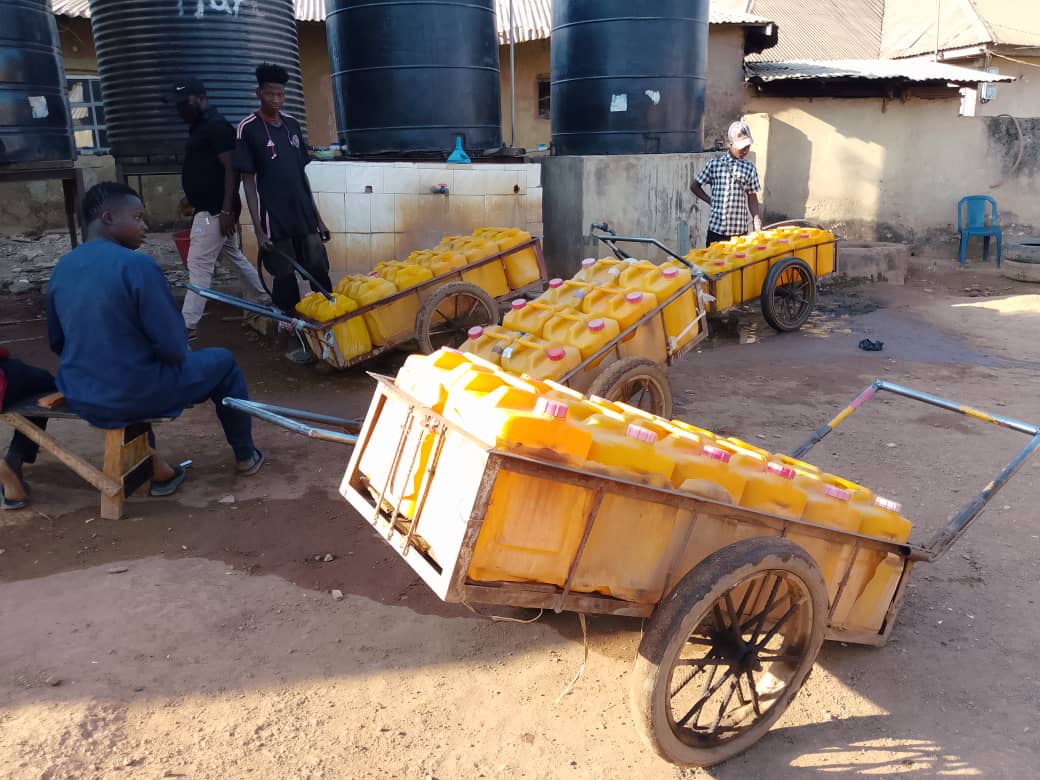
In Piwoyi today, a 20 litre jerrican of water sells for as much as ₦50, while a cart of 20 gallons of 20 litres of water costs between ₦1,200 and ₦1,500 an amount that can only sustain a household of four people for three days at best. This is an average of N12,000 per month. This is asides the cost on drinking water.
For a minimum wage owner, the cost on water is prohibitive. This has forced some residents who can’t afford the cost to access unhygienic water from wells and nearby streams.
The rising cost of water has sparked widespread frustration and concern within the community.
Reacting to the situation, the Zaki of Piwoyi Community, Tanko L. Buhago, expressed deep dissatisfaction with the lack of response from the government. He revealed that repeated efforts to reach the authorities through their elected representatives have yielded no tangible results.
Residents have also voiced their exhaustion and distress. Speaking during an interaction, Payama, a resident, lamented the daily struggle to access clean water for drinking and household use. He described the situation as both stressful and expensive, noting that children are often forced to trek long distances with heavy containers on their heads in search of water. According to him, water vendors locally known as Milowa are frequently unavailable due to overwhelming demand.
Payama further appealed to the government to urgently intervene, pointing out that Piwoyi hosts the National Defence Quarters and is situated between Federal Housing Authority estates in Lugbe. Despite its strategic location, the community remains abandoned, he said.
The lingering question remains: why should residents of Nigeria’s Federal Capital Territory endure such harsh living conditions for years while their pleas go unanswered? Water, as residents rightly emphasize, is life. It is an essential commodity and a fundamental basic amenity that government owes its people.
This report serves as a strong call to relevant government authorities to heed the cries of Piwoyi residents. Beyond water, the community also requires improved road infrastructure to ease movement and improve overall living conditions. The people of Piwoyi are yearning for action not promises.