

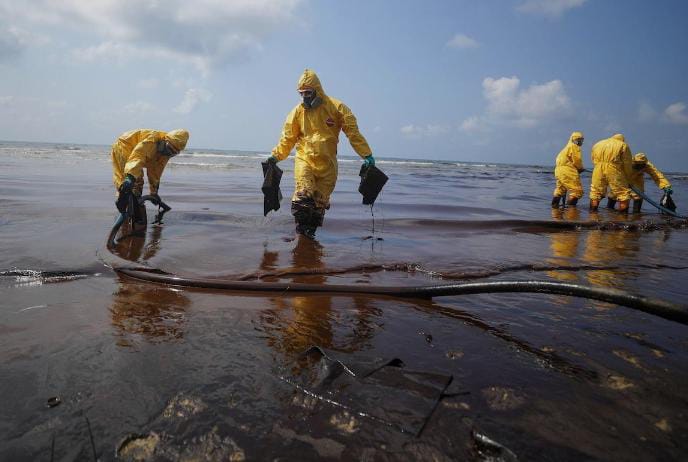

Nigeria is in the middle of an environmental polycrisis. From oil spills in the Niger Delta to desertification in the North, gully erosion in the South-East, coastal flooding in Lagos, and illegal mining across the hinterlands, the country’s ecological base is under severe strain.
Yet, the loudest response from government has remained the same: pass another law, set up another agency, enforce another regulation.


That is why the call by Dr. Patterson Ogon, Director of Planning, Research and Statistics at the NDDC, to make Environmental Education (EE) the fourth pillar of ecological governance is both timely and urgent. Laws without literacy, enforcement without understanding, and policies without public buy-in will continue to fail.
Dr. Ogon’s lead paper at the Environmental Education Summit in the University of Port Harcourt laid bare the scale of the problem.
According to NOSDRA, more than 754,000 barrels of crude oil were spilled into Nigeria’s environment between 2006 and 2022 — the equivalent of 3,769 tanker trucks, Bayelsa, Rivers and Delta bore the brunt.
A 2023 report by the Bayelsa Oil and Environmental Commission found out that Nigerian pipelines leak far more frequently per 1,000km than those in the EU. An independent review of 6,300 oil spills between 2010 and 2015 showed that only 4% were remediated, while 90% had no post-clean-up assessment.
Add to this the 38-day Santa Barbara blowout in Nembe (2021), recurring gas incidents in Bille Kingdom, and the slow official response compared to the $20 billion Deepwater Horizon fund set up by the U.S. within weeks in 2010.
The message is clear: we do not just have an environmental problem. We have an accountability, capacity, and awareness problem.
Environmental illiteracy is not an academic gap. It is a governance failure.
When communities do not understand the link between mangrove destruction and coastal flooding, they sell land to developers. When leaders do not grasp the connection between deforestation and desertification, they approve projects without safeguards.
As Dr. Ogon put it: An environmentally uninformed leadership is a disaster waiting to happen.”
With Nigeria’s population projected to hit 400-440 million by 2050, unchecked resource exploitation and weak ecological awareness will directly threaten public health, food security, livelihoods, and economic stability.
For decades, ecological governance in Nigeria has rested on three pillars: Law, Regulation, and Enforcement.
What has been missing for years is the “Knowledge and Values”.
The proposed Port Harcourt Framework for Environmental Education and Ecological Governance offers a roadmap:
- A National Environmental Education Policy and Strategic Plan (2026–2035).
- Inter-agency collaboration between NOSDRA, NESREA, HYPREP, and NOA.
- Community-based environmental learning tailored to local risks.
- University-driven research on mangrove restoration, flood management, and the Niger Delta blue economy
Possible solution for ecological crisis
- Mainstream environmental education into school curricula, adult education, NYSC orientation, and leadership training.
- Budget for it. The 2026-2035 plan needs funding, not just a launch.
- Popularize the data. The 754,000-barrel figure should be as familiar as inflation rates.
- Tie corporate responsibility to education. Oil and mining firms should fund community environmental education as part of their social license.
Nigeria cannot police, sue, or clean its way out of this crisis alone. Without a population that understands and protects its environment, every law will be circumvented and every clean-up will be temporary.
As Dr. Ogon noted, “Investing in environmental education is an investment in healthier environments, stronger institutions, resilient communities and a sustainable national future.”
The diagnosis and prescription are here. What is left is political will.
The time to act is now — before the next 400 million Nigerians inherit a broken ecosystem.