



By ZAKAA LAZARUS
Troops of Operation Hadin Kai have repelled coordinated attacks by ISWAP terrorists across multiple fronts in Borno State, killing several fighters, destroying logistics platforms and reinforcing military dominance in the North-East theatre.
The Joint Task Force disclosed that the failed assaults on Limankara and Kukawa communities were foiled following fierce engagements between troops and insurgents, who suffered heavy casualties and were forced into disorganised retreat.
According to a statement issued by the Media Information Officer of Operation Hadin Kai, Lieutenant Colonel Sani Uba, the military said the attacks, launched on the night of February 20, 2026, reflected mounting pressure on terrorist enclaves, logistics routes and leadership structures.
According to him, sustained offensives and targeted strikes have continued to deny terrorists freedom of action, forcing them into chaotic withdrawals.
In a related development, troops under Sector 2 conducting Operation Desert Sanity V carried out a precision offensive around Lamusheri Village in Gujba Local Government Area of Yobe State in the early hours of February 22, following weeks of intelligence gathering supported by satellite imagery and aerial surveillance.
The military said the location had been identified as a major terrorist logistics hub and staging ground for attacks.
“Despite coming under fire on approach, troops in synergy with members of the Civilian Joint Task Force outflanked the terrorists and cut off their withdrawal routes,” the statement said.
During the operation, 15 terrorists were neutralised, while several others escaped with gunshot wounds.
Troops also destroyed defensive positions and logistics structures, set ablaze five terrorist tricycles and two vehicles used for mobility and attacks, and recovered weapons, ammunition, bandoliers and other combat equipment.
On the same night, terrorists attempted to infiltrate the Forward Operating Base at Limankara but were met with immediate resistance from alert troops.
With rapid reinforcements and support from the Air Component, the attackers were overwhelmed and forced to flee through the burial ground axis.
The military confirmed that no casualties or equipment losses were recorded among troops, although intelligence indicated that the terrorists suffered significant losses.
In Kukawa, insurgents mounted on gun trucks and motorcycles launched a coordinated multi-directional assault from the Alagarno and Jemmu axes.
Troops, however, mounted a determined defence, engaging the attackers in a prolonged firefight that lasted into the early hours of February 21.
Supported by air power, ground forces overpowered the terrorists, who retreated while evacuating their dead and wounded.
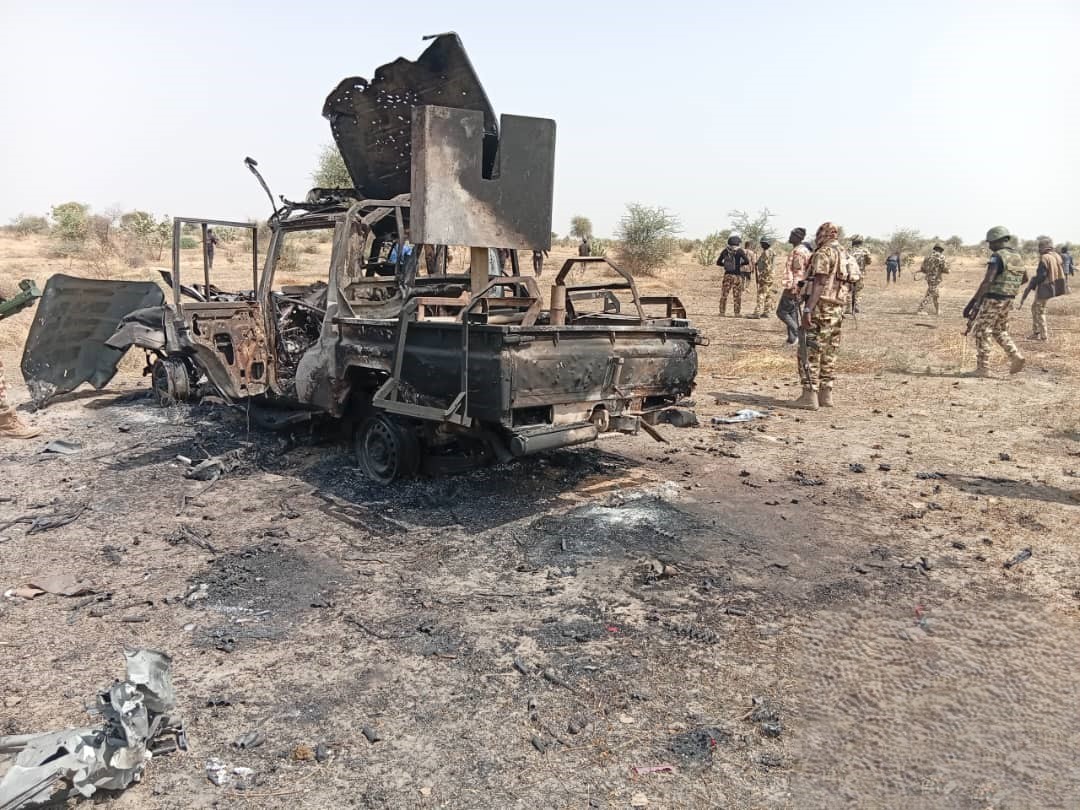
Air strikes during the engagement destroyed a terrorist gun truck, killing four fighters, while additional precision strikes targeted fleeing insurgents on motorcycles, destroying five motorcycles and neutralising 10 more fighters.
Troops conducting follow-up exploitation recovered 13 AK-47 rifles, 16 loaded magazines, three handheld communication radios and other equipment abandoned by the fleeing insurgents.
They also discovered stretchers used to evacuate casualties, shallow graves and blood trails along terrorist withdrawal routes.
However, the military said one soldier was killed during the engagement, while some equipment was damaged by rocket fire.
The wounded personnel were evacuated by Nigerian Army Aviation helicopters and are currently in stable condition.
The military said the coordinated land and air operations had significantly degraded terrorist fighting capability and reinforced operational superiority across the theatre.
The High Command commended the troops for their performance and urged them to sustain the offensive tempo in ongoing operations aimed at eliminating terrorist threats in the region.