


By Kiso simon
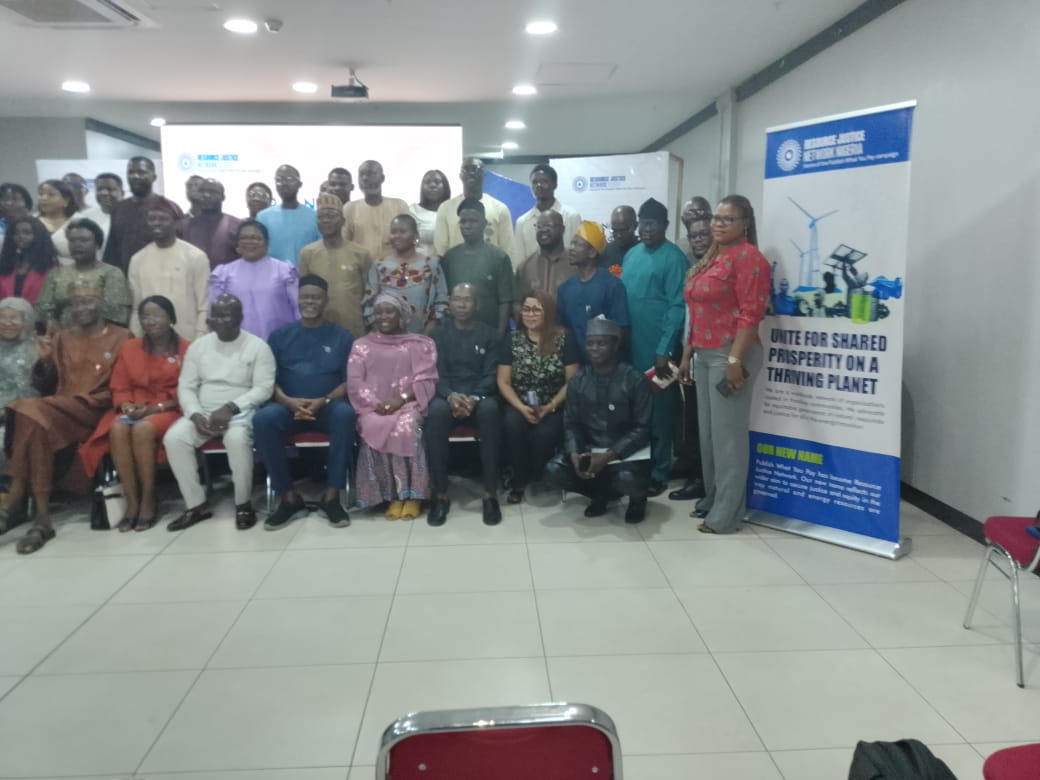
The Resource Justice Network Nigeria has launched its 2025–2028 Strategic Plan and convened a partner dialogue in Abuja under the theme, “Advancing Resource Justice in Nigeria: Towards an Ecosystem Approach.”

The event, held at Novare Mall, Abuja, brought together stakeholders from different sectors of society who advocated justice, fairness, transparency, and equitable distribution of Nigeria’s natural resources.
Declaring the event open, the Executive Director of Resource Justice Network Nigeria welcomed participants and described the gathering as an important moment of reflection on the organisation’s journey from Publish What You Pay Campaign Nigeria to its new identity as Resource Justice Network Nigeria.
She said the transition reflects over two decades of impactful advocacy by civil society organisations in promoting transparency, fighting corruption, supporting economic recovery, and contributing reforms in Nigeria’s extractive sector. She urged stakeholders to sustain efforts toward strengthening the Nigerian Minerals and Mining Act and other governance frameworks.
According to her, the activities of the organisation now go beyond revenue transparency to include community rights, environmental sustainability, and addressing the global climate crisis.
She noted that Nigeria occupies a critical position due to its dependence on fossil fuels while navigating the global energy transition. She said the organisation is repositioning itself to respond to these realities through its strategic vision for 2030, as reflected in the newly launched partnership framework.
She added that Nigeria stands at a crossroads, with sub-national governments grappling with climate change, insecurity, and developmental pressures, stressing that the gathering was not only to unveil a new chapter but also to celebrate the legacy of the movement.
“The new vision of Resource Justice Network Nigeria represents a broader purpose where resources are distributed equitably while promoting social justice and environmental protection,” she stated.
Speaking at the event, Executive Director of the Africa Network for Environment and Economic Justice (ANEEJ), Rev. David Ugolor, commended the organisation for its journey and achievements.
He recalled that when Publish What You Pay Campaign Nigeria began, its mission was to promote transparency, accountability, and citizen participation in the governance of natural resources.
He said the collective efforts of stakeholders had contributed significantly to reforms, particularly strengthening transparency institutions such as the Nigeria Extractive Industries Transparency Initiative (NEITI).
According to him, NEITI data has provided credible insight into how Nigeria’s oil revenues are managed, deepened public understanding, informed policy discussions, and empowered citizens to demand accountability.
However, he stressed that transparency alone is not enough, noting that poverty persists, especially in resource rich communities that have yet to benefit fully from Nigeria’s wealth.
He therefore called for a shift to a broader resource justice framework focused on equity, inclusion, environmental sustainability, and fair distribution of benefits.
In his goodwill message, Dr. Basil applauded Resource Justice Network Nigeria for its sustained advocacy for transparency and equitable resource management, encouraging the organisation to remain steadfast.
Also speaking, Vincent Egoko, Head of the African Resource Justice Network, highlighted Nigeria’s strategic importance in the global economy and praised the Nigerian chapter for building a strong continental movement.
Representing Awolo through GGT Nigeria, Tunde Salman commended the conveners for bringing stakeholders together at a critical time. He stressed that resource justice is not only about sharing resources, but ensuring that all affected communities receive their fair benefits.
He said the organisation remains an important platform for addressing equity, accountability, anti-corruption, and inclusive governance.
Delivering the keynote address, Dr. Otive Igbuzor said Nigeria is currently positioned at the intersection of two global realities: the urgent need for energy transition and the increasing demand for justice in natural resource governance.
He argued that energy transition must go beyond a technical shift from fossil fuels to renewable energy and embrace deeper social, environmental, and political transformation.
Dr. Igbuzor said Nigeria’s development history has been deeply tied to resource extraction, from crude oil to solid minerals, yet the country continues to experience the paradox of immense wealth alongside persistent poverty.
He cited the Niger Delta as an example, where despite decades of oil production, communities still suffer environmental degradation, underdevelopment, and social marginalisation.
According to him, many oil-producing communities bear the burden of pollution, biodiversity loss, waste discharge, destroyed livelihoods, acid rain, and severe health challenges.
He blamed the situation on weak institutions, elite capture, and limited community participation, adding that Nigeria’s problem is not a lack of resources but a governance deficit.
On energy transition, he said the global push away from fossil fuels presents opportunities for Nigeria to diversify its economy, but warned that it could also reproduce existing inequalities if not properly managed.