





One of the country’s prominent policy groups, the Independent Media and Policy Initiative (IMPI) wants the National Assembly to invoke the doctrine of necessity with a view to speeding up the process of establishing state police.
In a policy statement signed by its Chairman Dr Omoniyi Akinsiju, the think tank expressed concerns at the delay in putting a decentralised policing structure in place.
IMPI said: “We posit, in this regard, that the police force should be the foundation of the country’s internal security architecture. In consideration of this, we acknowledge efforts that are being made to establish the State Police as part of the nation’s security apparatus.
“Our argument is hinged on the fact that police officers must be recruited from and deployed to the local environment they are familiar with.
“The would-be police officers are better placed because of their knowledge of the culture and familiarity with their environment. We, therefore, call on the National Assembly to invoke the doctrine of necessity to ensure the passage of the law creating State Police without delay.”
It also urged state governments to ensure that various communities and stakeholders are involved in security matters in their respective domains.
“Additionally, governments at all levels should facilitate community involvement in security matters through community mobilisation. Community mobilisation is a process of engaging and empowering members of a community to take ownership of and actively participate in addressing issues and challenges facing the community.
“It involves bringing together various stakeholders within a community, such as community leaders, local organisations, and government agencies, to work towards a common goal.
“It is aimed at fostering solutions that support good governance, accountability, representative participation, and peaceful change. Participation in community mobilisation is about addressing the interests of the entire community, with security at the top,” IMPI added.
End
[10/06, 15:52] Osby: Despite challenges, Tinubu’s war against terrorism not failing-IMPI*
The latest study by the Independent Media and Policy Initiative (IMPI) has shown that despite challenges as reflected in the recent spate of kidnappings, the Prssident Bola Ahmed Tinubu’s led federal administration’s war against terrorism has not not failed.
According to the policy think tank, no fewer than 8,000 terrorists have been neutralised by security operatives using newly acquired platforms in different military operations in the country.
In a policy statement signed by its Chairman Dr Omoniyi Akinsiju, IMPI argued that the counter- terrorism initiative of the Bola Tinubu administration have been largely successful, especially in recent times.
It said: “From our study of the federal administration’s counter-terrorism efforts, it is indisputable that the President Bola Ahmed Tinubu administration has recorded notable tactical successes in the fight against banditry.
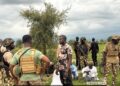
“Between 2023 and now, the police and military offensives have led to the neutralisation of over 8,000 bandits and terrorists, with 11,600 criminals arrested, and the recovery of thousands of weapons. As recently as 6 June, 2026, Operation HADIN KAI troops rescued 360 kidnapped victims from a heavily fortified terrorist enclave hidden deep within the Mandara Mountains of Borno State.
“Earlier, in the Yagba West area of Kogi State, troops of the Nigerian Army 12 Brigade and local vigilantes rescued two kidnap victims after pursuing fleeing terrorists. Similarly, in May and June 2026, operations in Borno State saw massive search-and-rescue efforts that freed hundreds of individuals, and in Kwara State, joint operations by the Nigerian Army and Air Force rescued 21 victims.
“Additionally, recent efforts by the federal administration have resulted in major rescue of citizens abducted by kidnappers and bandits in Kebbi, Kaduna, Niger, Kwara and Borno States, making a paradigm shift from the past.”
The policy group also detailed some of the strategies deployed by security agencies in the war against terrorism
“The military relies on several key strategies to secure the release of captives. In addition, troops frequently launch swift, aggressive pursuit operations into forests, mountainous terrain, and caves, such as the Mandara Mountains in Borno and the Babanla Forest in Kwara. The physical pressure from these sweeps forces armed bandits or insurgents to abandon their captives and flee.
“Likewise, when kidnappers demand large ransoms and threaten to kill victims, military intelligence track their movement and deploy covert rescue tactics. For instance, troops in Plateau State deployed these methods to rescue a retired military officer from a ₦200 million ransom situation without paying a kobo.
“Security operatives utilise Intelligence, Surveillance and Reconnaissance (ISR) before launching air strikes. Precision air strikes or drone sweeps frequently dislodge militant hideouts, providing captives the opportunity to break free and find safety. The rescued individuals typically receive initial first aid, trauma support, and food at field ambulances or military medical facilities before being handed over to state governments for family reunification,” it said.
IMPI argued that recent success stories from the frontlines were as a result of investments in military hardware, and improved training of operatives.
“It will not be out of place to credit these outcomes to the Tinubu administration’s major investments in both military and presidential aviation. Key procurements and deliveries across the Nigerian Armed Forces and military air assets that include 24 advanced M-346FA fighter jets, four T-129 ATAK helicopters, and five Agusta 109S Trekker helicopters.
“The Nigerian army is also equipped with 12 MD 530F Cayuse attack helicopters to operationalise the newly established army aviation unit. Deliveries also include Diamond DA62 surveillance aircraft and King Air 360i multi-purpose aircraft.
“The administration has also implemented extensive training and capacity-building programmes for the Nigerian Armed Forces, comprising the establishment of new training depots, including a facility in Abakaliki/Amasiri-Edda, Ebonyi State, expanding the total number of army training depots to three, alongside those in Zaria and Osogbo.
“The administration is also partnering with allied nations, including sending approximately 200 officers and soldiers to Türkiye for advanced special forces and tactical training and securing defence and advisory arrangements with nations like France to improve interoperability in joint operations.
“Similarly, the government has launched an elite Special Operations Force programme focusing on counterterrorism, counterinsurgency, intelligence gathering, cyber warfare, and adaptability for high-risk missions. These elite troops have been deployed for many rescue operations in recent times,” think tank noted.
It however added that more still needed to be done in the area of technology to boost the operational readiness of security operatives as well as addressing socio-economic factors in remote areas which criminal elements latch on to perpetrate criminality.