




by Alex Adum
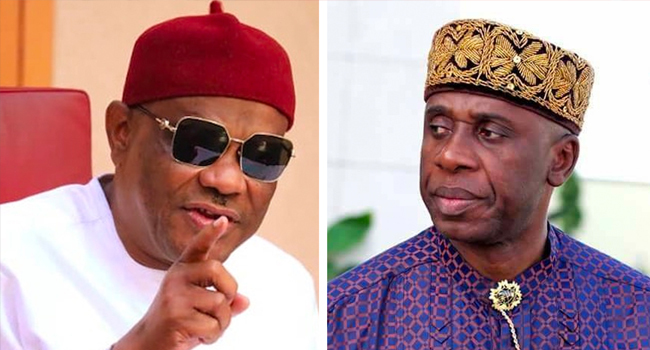
I listened to Wike’s monthly media chat, where he upbraided and spoke vilely about Amaechi. And I wish to respond with respect that Wicke’s argument is politically convenient but hopelessly inconsistent.


If Rotimi Amaechi is to be condemned because he opposed President Goodluck Jonathan’s re-election, then the same standard must apply across the board. Wike has, over the years, consistently undermined President Jonathan and Dame Patience Jonathan, the very political family that facilitated his rise to power and made him Governor of Rivers State. He has also repeatedly disparaged respected South-South leaders, including Chief Peter Odili and Mary Odili, and Sen John Azuta Mbata. It therefore rings hollow for him to suddenly present himself as the custodian of South-South political solidarity.
Even more contradictory is his selective outrage. The Bola Tinubu administration in which Wike proudly serves was at the forefront and the principal political beneficiary of the South-South’s loss of presidential power. Tinubu was one of the National Leader in the coalition that vigorously opposed Jonathan’s second term and ultimately displaced his government in 2015. Today, Wike serves that same Tinubu without reservation.
Furthermore, the same administration Wike now defends conspired with the previous APC administration of Mohammadu Buhari to remove the then Chief Justice of Nigeria, Walter Samuel Nkanu Onnoghen, another distinguished son of the South-South, under deeply controversial circumstances. If Wike’s concern is truly about the political and institutional marginalisation of the South-South, why is all his indignation reserved for Amaechi while he enthusiastically works for and defends the man who was the chief architect and greatest political beneficiary of the South-South’s displacement from the presidency? That contradiction exposes his argument as one of convenience rather than conviction.
His assertion that Amaechi has nothing to tell Rivers people equally ignores political reality. Elections are contests of ideas, leadership and measurable performance, not selective historical revisionism. Amaechi can point to his record as Speaker of the Rivers State House of Assembly, Governor of Rivers State, Minister of Transportation and Director-General of a successful presidential campaign. Whether the electorate accepts that record or not is entirely their democratic choice to make not Wike.
More importantly, Wike should account for his own legacy. Since becoming Minister of the Federal Capital Territory, what concrete benefit has Rivers State derived from his proximity to President Tinubu? His most visible contribution has been political brigandage, deepening political instability in Rivers State, endorsing constitutional aberrations and supporting the controversial declaration of a state of emergency that suspended democratic governance in the state. That unfortunate episode tarnished Rivers State’s democratic reputation, weakened constitutional governance and coincided with widespread allegations of the pillaging of the state’s resources. That is hardly a record that compares favourably with Amaechi’s.
On development, the comparison becomes even more difficult. As Minister of Transportation, Amaechi initiated and awarded the Port Harcourt–Maiduguri Railway Project, one of Nigeria’s most strategic rail corridors, reconnecting the South-South, South-East, North-Central and North-East with immense economic potential for Rivers State. That project alone has enduring national and regional significance.
By contrast, Wike’s tenure as FCT Minister has been overshadowed by persistent allegations of aggressive land allocations and acquisitions benefiting political allies and himself, while Rivers people are left asking what comparable federal infrastructure or economic project he has attracted to their state.
Ultimately, Wike’s argument defeats itself. If opposing a South-South President permanently disqualifies Amaechi from seeking office, why does that principle not apply to Tinubu, whom Wike now serves with unmatched enthusiasm? If loyalty to the South-South is the test, then Wike owes Rivers people an explanation for supporting and defending the principal political beneficiary of the South-South’s removal from presidential power while reserving his attacks exclusively for Amaechi.
That is not principle. It is selective morality, political opportunism and historical revisionism driven by expediency rather than conviction.
Finally, Wike’s logic raises an uncomfortable question for the Tinubu administration. If the South-South should reject Amaechi because he once opposed a South-South President, what should the North make of Vice President Kashim Shettima? Should Northerners conclude that remaining Vice President to Tinubu from the South is preferable to producing the President from the North? Or does Wike’s regional argument apply only when it suits his politics?
Politics should be driven by vision, competence and national interest, not selective historical narratives crafted for momentary political advantage.
Alex Ter Adum, PhD
DDG THE NARRATIVE FORCE