



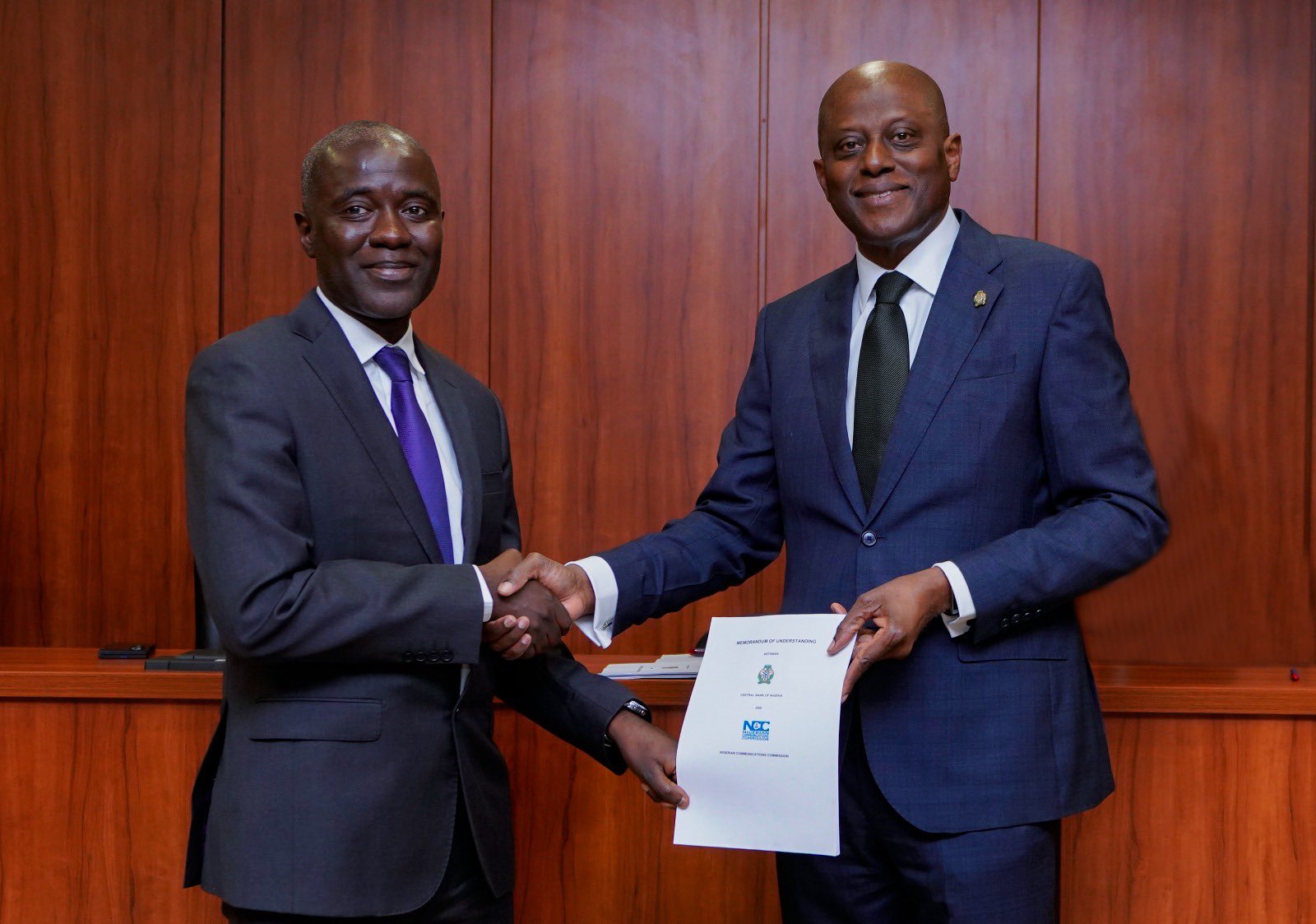

The Central Bank of Nigeria (CBN) and the Nigerian Communications Commission (NCC) have entered into a strategic partnership aimed at transforming how data is shared, managed, and deployed across Nigeria’s financial and telecommunications sectors.
The agreement was formalised through a Memorandum of Understanding (MoU) signed at the CBN Headquarters in Abuja on Monday, April 20, 2026.
The signing was witnessed by the Governor of the CBN, Mr Olayemi Cardoso, and the Executive Vice Chairman and Chief Executive Officer of the NCC, Dr Dr. Aminu Maida.
The pact marks a significant milestone in Nigeria’s ongoing efforts to build a more resilient, data-driven regulatory environment that supports financial stability, enhances cybersecurity, and strengthens the country’s fast-growing digital economy.
At the core of the agreement is a commitment by both regulators to deepen institutional collaboration through structured and secure data exchange.
This includes improving access to real-time information, enhancing policy coordination, and strengthening oversight of activities within Nigeria’s interconnected financial and telecom ecosystems.
The initiative is also designed to break down long-standing silos between regulatory agencies, enabling faster responses to systemic risks while improving the quality of evidence-based policymaking.
The partnership also reflects growing recognition that data is now central to economic governance, particularly as Nigeria’s economy becomes increasingly digitalised.
With the rapid expansion of mobile banking, fintech services, and digital communications, regulators have raised concerns about rising cybersecurity threats, fraud risks, and data privacy challenges.
The CBN–NCC collaboration is expected to significantly improve the country’s capacity to detect and prevent cyber-related financial crimes, while also strengthening consumer protection frameworks across both sectors.
By integrating data systems and intelligence-sharing mechanisms, the two agencies aim to enhance early warning capabilities and reduce vulnerabilities within Nigeria’s financial infrastructure.
The MoU aligns with broader national objectives to position Nigeria as a leading digital economy in Africa. It is expected to support innovation in fintech, expand financial inclusion, and create a more transparent regulatory environment that encourages investment.
Stakeholders believe the agreement could also improve operational efficiency for both regulators, particularly in areas such as licensing, compliance monitoring, and enforcement actions.
Speaking after the signing, both institutions underscored the importance of collaboration in managing the complexities of Nigeria’s evolving digital landscape.
They noted that closer coordination between financial and telecommunications regulators is no longer optional, but essential for maintaining stability in an increasingly interconnected economy.
Analysts view the partnership as a forward-looking model for governance in the digital age, where cross-sector data integration is becoming critical to effective regulation.
The CBN–NCC MoU is expected to serve as a blueprint for future collaborations among government agencies seeking to harness data as a strategic national asset.
As Nigeria continues its transition toward a fully digital economy, the success of this partnership could play a defining role in shaping the country’s financial resilience, cybersecurity posture, and global competitiveness.