




By ZAKAA LAZARUS
The Conservator-General of the National Park Service, Dr. Ibrahim Goni, has appealed to host communities of Oba Hills National Park in Osun State to make sacrifices for national development, assuring them that the park will bring long-term benefits beyond employment.


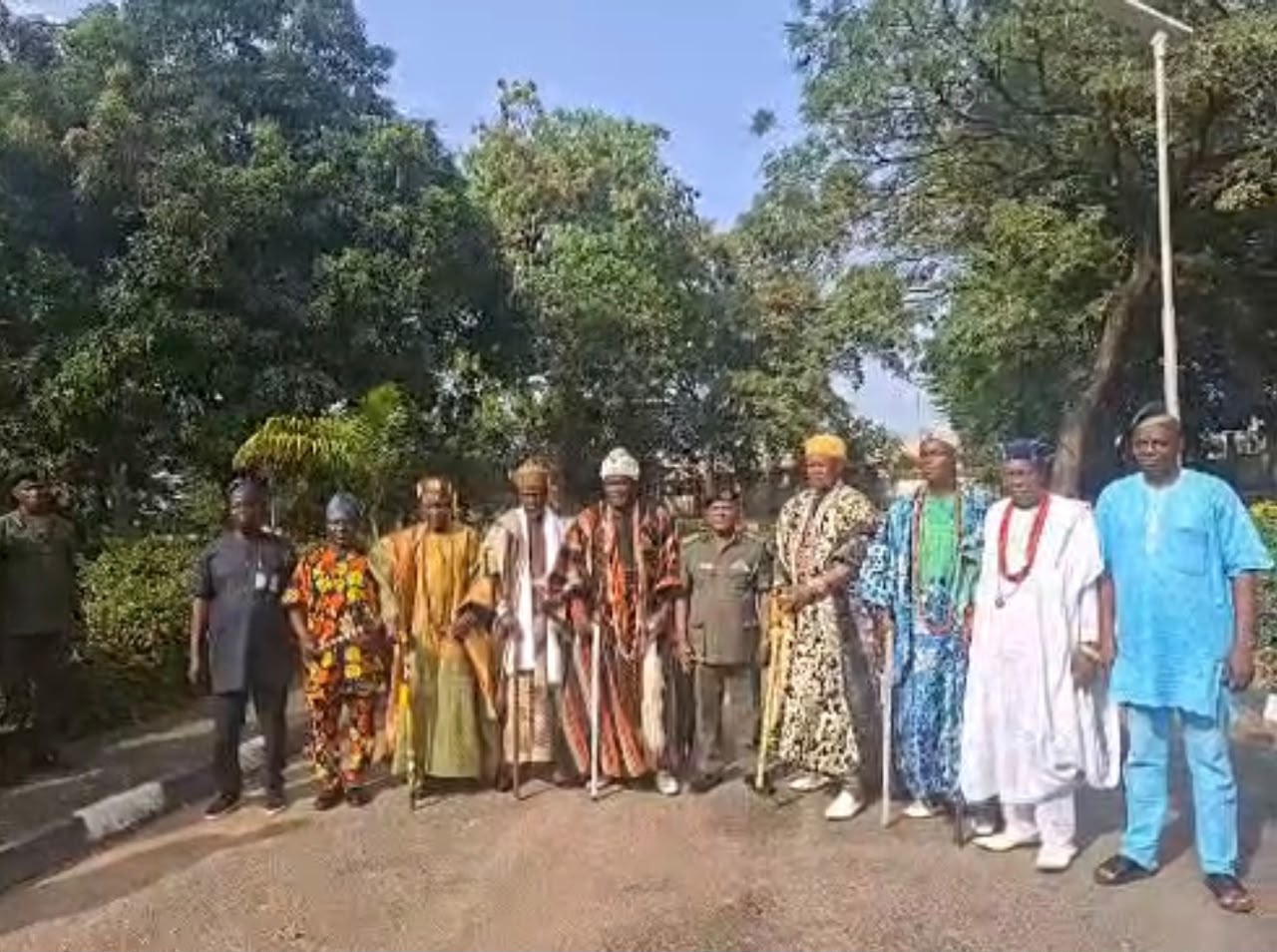
Dr. Goni made the appeal on Monday in Abuja when traditional rulers from communities surrounding Oba Hills National Park paid a courtesy visit to the Service headquarters.
He said land management remains one of the most sensitive issues globally, hence the Federal Government’s deliberate approach to mediating conflicts arising from protected areas.
The Conservator-General commended Osun State Governor, Senator Ademola Adeleke, for sustaining efforts to upgrade the former Oba Hills Forest Reserve to a National Park, a process which he said came to fruition in 2020 when former President Muhammadu Buhari approved 10 new National Parks.
Tracing the history of the reserve to 1923 during the colonial era and its formal declaration in 1953, Goni said the upgrade to National Park status has placed Oba Hills on the global conservation map.
He explained that the benefits of a National Park are both direct and indirect, ranging from climate change mitigation, erosion and pollution control to improved rainfall, employment and eco-tourism.
“The vegetation around you mitigates a lot of problems. That is why Osun has two planting seasons. These are benefits of keeping your vegetation untouched,” he said.
On employment, the Park boss disclosed that the Service is absorbing former staff of the Osun State Ministry of Environment who worked in the reserve, and not importing staff from elsewhere. He, however, cautioned that recruitment must comply with the Federal Character principle.
“I want to disabuse your mind that because the park is in your place, you must dictate the number to be employed. Federal Character must come into play. Whatever number is given to you, manage it in the spirit of sacrifice,” he said.
Drawing from his personal experience as an indigene of New Bussa where the Kainji Dam was built, Goni said sacrifice is necessary for national progress. “We left Old Bussa for New Bussa. If we really want this country to progress, we have to make sacrifices.”
Goni further disclosed that the Service has concluded work on the removal of exotic tree species found in the park. He said a committee report has been sent to the Minister of Environment for approval to replace them with indigenous species, which informed the ongoing planting of 11,000 indigenous seedlings supported by partners including the Nigerian Conservation Foundation.
“A National Park is not a no-go area. We are talking about sustainable management. If we have trees that can provide local maggi, bush mango and ogbono, we will organise your women in groups to harvest them under guidance,” he said, adding that Non-Timber Forest Products are already being harvested sustainably in Cross River National Park.
On the request for physical structures inside communities, he said the United Nations now discourages construction inside protected areas to avoid destruction of biodiversity, hence the Service now sites ranger barracks only at park boundaries and entry points to check illegal hunting, logging and mining.
He assured the traditional rulers that the Service would introduce smart agriculture and agroforestry, allowing communities to cultivate cassava, yam and maize under trees without cutting them down, while discouraging crops with long creepers.
Goni also clarified the funding structure for traditional institutions, noting that host communities are accommodated through the Governing Board, Management Committee and Local Advisory Committee, where traditional rulers and community representatives are appointed and paid allowances.
Earlier, Secretary of the Oba Hill Traditional Council, Mr. Shedrack Adebayo Adelakun, had pledged the communities’ support for conservation, but demanded 70 percent of jobs for indigenes, physical development of host communities, urgent boundary demarcation to check illegal miners around Akinyele Town, and budgetary provision for traditional rulers.
Similarly, the Olu of Akinyele, Oba Nafiu Abiodun Taofeek, said initial fears about the National Park had been allayed by sustained sensitisation by the Acting Conservator of Parks, ACP Olakunle Azeez, whom he described as “a man of God.”
Oba Taofeek appealed for employment for educated but jobless youths who have resorted to farming, warning that taking their farmland without alternatives could push them into crime.
“If you leave a person who went to secondary school with no work, and you take his farmland, a person without work can do bad things. We want our boys to be like you. It is pride when someone says my child works in the National Park,” he said.
In his remarks, the Acting Conservator of Parks, Oba Hills, ACP Olakunle Azeez, thanked the Conservator-General for granting express approval for the visit despite short notice, and commended the traditional rulers for their support.
Dr. Goni assured that with sustained Federal Government support and community cooperation, Oba Hills could become a major eco-tourism destination like parks in Kenya, Zimbabwe and Tanzania, describing it as a potential “Jerusalem or Mecca” for nature lovers.